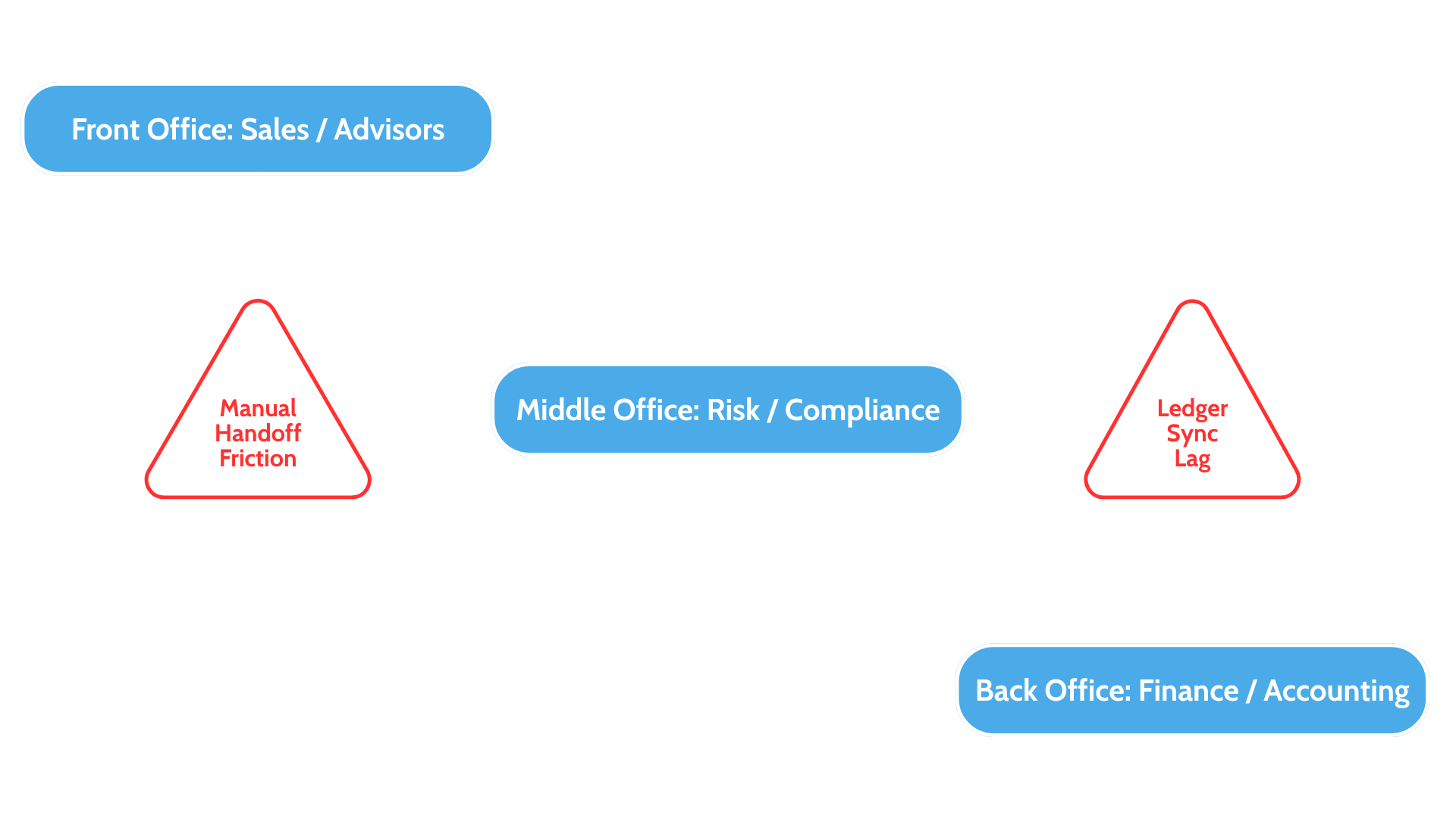
In tier-1 capital markets, speed is the ultimate currency. Yet, inside many of the world’s leading financial institutions, a hidden tax is being paid on every single transaction. It’s called deal drag; the friction, operational latency, and lost momentum that occurs when a high-value transaction gets stuck in the bureaucratic no-man’s-land between internal departments. For decades, the Front Office (investment bankers and relationship managers), the Middle Office (risk, legal, and compliance), and the Back Office (finance, operations, and accounting) have operated on entirely separate islands of technology – without a unified CRM ecosystem. The relationship manager tracks a prospective £50 million corporate credit facility in a standalone CRM. Meanwhile, the risk team evaluates the borrower’s liquidity profile using specialised underwriting software, and the back-office finance team manually reconciles the finalised terms inside a legacy ledger or ERP system.
This fragmentation creates a compounding financial penalty:
-
Siloed Systems = Lost Wallet Share:
When front-office advisors lack visibility into the active products a client holds across other bank divisions, cross-selling stalls and competitors step in.
-
The Compliance Bottleneck:
When Know Your Customer (KYC) and Anti-Money Laundering (AML) checks require middle-office analysts to manually pull data out of front-office notes, deal cycles stall by weeks.
-
Revenue Leakage:
When deal modifications made mid-quarter by the front office are not instantly synced to back-office billing systems, the bank experiences immediate margin erosion and faces heightened regulatory audit risks.
The Cost of the Disconnect: Front, Middle, and Back Office Silos ⛓️💥
When a financial institution’s technology stack is siloed, a predictable pattern of operational friction emerges across the life cycle of every deal:
The Front-Office Illusion 🔮
To a relationship manager, a modern, cloud-based CRM looks like a success. They can track interactions, manage pipelines, and forecast closures. However, if that CRM is decoupled from the rest of the organisation, those forecasts are built on sand. Sales reps routinely pitch structured financing or corporate loans without a real-time understanding of the firm’s current credit risk appetite or capital allocation limits, leading to a promised deal terms that the institution cannot safely fulfill.
The Middle-Office Black Box ⬛
Once a mandate is signed, the deal enters the middle office for credit underwriting, legal review, and compliance vetting. Because the middle office operates in a separate system, the front office loses all visibility. Relationship managers are forced to ping risk analysts via email or chat for status updates, while clients grow frustrated by the radio silence.
The Back-Office Scramble ✍️
When the deal finally closes, the handoff to the back office is frequently manual. Contract modifications, tiered fee structures, and customised covenant clauses are re-entered by hand into accounting systems. This duplicate data entry introduces human error, delays the recognition of revenue, and complicates compliance with strict auditing standards like ASC 606.
How Can a Modern CRM Align Credit Risk and Relationship Managers? ↔️
Aligning the front and middle offices requires embedding compliance and risk frameworks directly into the relationship manager’s daily workflow. A modern financial services CRM accomplishes this by acting as a collaborative platform rather than a static database.
Proactive Risk Guardrails 🚧
Rather than waiting for a deal to reach the underwriting stage to discover a credit mismatch, a unified CRM feeds middle-office risk parameters directly into front-office dashboards. As a relationship manager structures a corporate loan or syndication, the CRM evaluates the deal parameters against real-time credit risk thresholds. If a proposed interest margin or leverage ratio violates current risk appetite guidelines, the system flags it instantly, before the proposal ever reaches the client’s desk.
Streamlined KYC (Know Your Customer) / AML (Anti-Money Laundering) Workflows 🪪
By integrating middle-office compliance tools into the CRM, client onboarding transforms from a sequential bottleneck into a parallel process. Identity verification, beneficial ownership mapping, and AML (Anti-Money Laundering) screening are triggered automatically based on CRM data fields. Risk teams receive clean, pre-populated dossiers to review, allowing them to issue approvals faster and significantly reduce time-to-revenue for new institutional accounts.
Eliminating Manual Reconciliation in the Back Office 📳
The final link in a unified financial ecosystem is the integration between the CRM and the back-office ledger. When the front office wins a deal, that event should trigger an automated sequence across the bank’s entire financial infrastructure.
Automated Contract Off-Ramps 🚏
When an investment banking mandate or commercial lease is marked as “Closed-Won” in the CRM, a modern ecosystem automatically pushes the finalised contract variables, including complex fee schedules, milestone-based triggers, and billing entities, directly into the ERP and accounting systems. This eliminates the need for manual data entry, ensuring that the first invoice sent to the client perfectly matches the terms negotiated by the sales team.
Bulletproof ASC 606 and Audit Trails 📝
Under revenue recognition standards like ASC 606, capital markets firms must demonstrate a completely transparent, unalterable trail from the initial contract signature through to revenue allocation. A front-to-back CRM integration automatically logs every mid-market contract amendment, fee concession, or milestone shift. When external auditors sample transactions, the bank can provide a clear, chronological audit trail linking the front-office opportunity directly to the back-office financial ledger, minimising compliance risk and preventing costly restatements.
The “Aspire” Operational Framework 🚀
When top-tier financial institutions aspire to true operational excellence, they look beyond the boundaries of traditional departments. They recognise that a CRM should not be deployed in isolation for the sales team. True market leadership requires a unified revenue ecosystem where credit risk thresholds, compliance audits, sales pipelines, and bank ledgers communicate in real-time, turning technology from an operational bottleneck into a distinct competitive advantage.