Claudeforce is the name Salesforce and Anthropic have given to their expanded strategic partnership, bringing Claude’s reasoning capabilities together with Salesforce’s data, workflows, business logic, actions and governance.
The partnership is broader than simply putting Claude inside Salesforce. The partnership works in both directions: Salesforce data, workflows and authorised actions can be accessed through Claude, while Claude is also available as a reasoning model within Salesforce’s Agentforce platform.
The initial release focuses on sales, with 37 prebuilt sales skills available through Salesforce in Claude. Salesforce and Anthropic say they plan to expand the partnership with additional integrations across Claude, Salesforce and Slack, as well as additional prebuilt skills.
For Salesforce customers, the significance is less about having another AI assistant and more about changing how people interact with their CRM.
What is Claudeforce?
It is useful to separate three parts of the partnership:
- Claudeforce is the name given to the broader Salesforce-Anthropic partnership.
- Salesforce inside Claude is the initial customer-facing integration, bringing Salesforce data, context and actions into Claude.
- Claude inside Salesforce refers to Claude’s integration into Salesforce’s own AI ecosystem, including Agentforce.
Salesforce data and business processes can be accessed through Claude, while Claude’s reasoning capabilities can be used within Salesforce.
What can Claudeforce do?
Rather than requiring salespeople to constantly switch between their CRM and an AI assistant, Claude can work with authorised Salesforce information and perform Salesforce actions. By default, Claude asks the user to approve each proposed change before it is written to Salesforce.
The initial release includes 37 prebuilt sales skills (functions), covering tasks such as:
- Preparing for customer meetings
- Reviewing account intelligence
- Assessing deal health
- Reviewing and updating pipeline
- Prospecting
- Improving pipeline hygiene
The important change is that the integration is designed to let Claude work directly with authorised Salesforce context and actions, rather than requiring users to manually copy CRM information into a conversation.
For example, a salesperson could ask Claude to prepare them for an upcoming customer meeting. Claude can use the relevant Salesforce context to help identify important account information, opportunities and risks, before the salesperson makes their next move. That moves AI from answering questions about CRM data towards working with the CRM itself.
So, what’s the difference between Agentforce and Claudeforce?
Agentforce is Salesforce’s platform for building and deploying AI agents. It allows organisations to create agents that can reason, access business data and take actions across Salesforce.
Salesforce inside Claude
Salesforce in Claude lets users interact with authorised Salesforce data and actions through Claude’s interface.
Claude inside Salesforce
Claude can also be used within Salesforce‘s AI ecosystem, including Agentforce. Salesforce has integrated Claude into its AI platform, including the Atlas Reasoning Engine, Agentforce Agent Builder and Agentforce experiences such as Agentforce Vibes and Agentforce Coworker.
The key value that the partnership brings is that it gives organisations more flexibility in how they build and deploy AI agents while continuing to work within the Salesforce environment.
How Slack fits into Claudeforce
Salesforce increasingly positions Slack as the place where people and AI agents can collaborate. Claude is being integrated into Slack through experiences including Slackbot, Claude Tag and Slack Code. The important part is not simply having Claude inside Slack. It is the connection between conversation, AI, Salesforce information and action.
For example, a sales team discussing an important customer in Slack could bring Salesforce context into the conversation and, where the relevant integrations and permissions allow, take action in Salesforce without leaving the workflow.
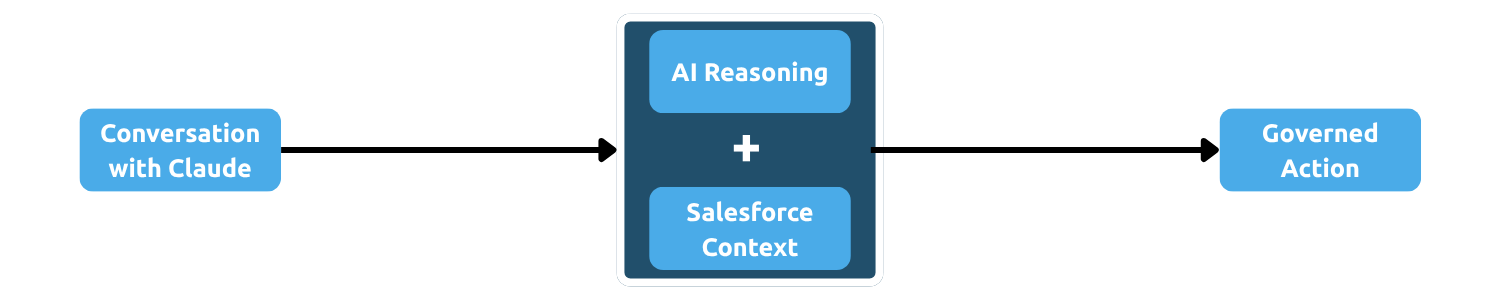
Security and guardrails
Claude’s access is tied to that of the user; Claude only has authorisation to see and do what that specific user is authorised for. Administrators connect Claude with Salesforce, after which users link their Salesforce accounts. Actions continue to operate through the user’s existing Salesforce permissions and business rules.
There is also flexibility around how much autonomy Claude is given. If desired organisations can require user confirmation for certain actions rather than allowing Claude to execute them automatically.
Enterprise Frontier Safeguards
Enterprise Frontier Safeguards are a separate set of controls being rolled out by Anthropic. They combine zero data retention with mechanisms designed to detect serious misuse. For eligible customers, Salesforce and Anthropic say activity data can be kept in customer-controlled cloud infrastructure, with customer-managed encryption keys, access policies and audit logging. Monitoring can also generate alerts for patterns that require customer review.
For organisations evaluating AI access to sensitive commercial information, these controls may be an important consideration. The question isn’t just whether an AI model is capable. It is whether the organisation can deploy that capability with sufficient visibility, control and governance.
AIforce and the role of MCP
Salesforce has developed AIforce, an enterprise framework that makes Salesforce data and capabilities available to AI agents through APIs, CLI tools and Model Context Protocol (MCP) servers.
MCP provides a standardised way for AI systems to interact with external tools and sources of information. In the context of Claudeforce, this provides a way for Claude to work with Salesforce’s business context, data and actions rather than treating CRM information as a separate static dataset.
This encapsulates a broader shift in enterprise software space. Instead of employees navigating an application to find information and perform an action, AI agents are more and more becoming an interface to the underlying business systems.
Salesforce as Customer Zero
As Salesforce often does, it has positioned itself as Customer Zero for the partnership’s tools. Rather than developing the technology entirely in isolation, Salesforce’s own sales team has used the capabilities on real accounts, opportunities and pipeline.
The early process involved Salesforce and Anthropic building and testing the integration, including connecting MCP servers, developing functions and establishing authentication processes. Salesforce says this approach allowed the technology to be tested against the workflows it was ultimately intended to support.
What could Claudeforce mean for Salesforce customers?
Salespeople spend a significant amount of time researching accounts, preparing for meetings, updating CRM records and managing pipeline.
But if an AI assistant can handle more of those tasks while working directly with authorised CRM data, the experience of using Salesforce could change considerably. For Salesforce customers, the potential implications include:
Less CRM administration
AI could help with activities such as pipeline updates, account research and CRM hygiene, reducing the amount of manual work required from sales teams.
More natural interaction with CRM data
Users could ask questions and give instructions in natural language rather than navigating through multiple Salesforce screens.
More capable agents
The combination of Claude’s reasoning capabilities with Salesforce data, business rules and actions creates the possibility of agents handling more complex, multi-step tasks.
Greater importance of data quality
Critically, AI agents are only as useful as the data and context they can access. If Salesforce data is incomplete, inconsistent or poorly maintained, the quality of AI-driven recommendations and actions will suffer. The arrival of more capable AI makes managing CRM data properly even more important.
What could this mean for the future of CRM?
Perhaps the biggest story behind Claudeforce isn’t the integration itself.
It is the changing role of the CRM. Traditionally, CRM software has been something employees open, navigate and update. Increasingly, the CRM is becoming a platform that AI agents can work with directly. Users can ask agents to find information, complete tasks and, where permissions allow, take actions rather than simply recommend them.
For Salesforce customers, the most pressing question may not be whether they should use Claude or Agentforce. It may become:
Which CRM processes should remain human-led, which should be AI-assisted, and which can safely become agent-led?
That is the conversation that new technology like Claudeforce is likely to make much more important in the years to come.
Considering how AI agents could work with your Salesforce environment? AspireCRM can help you assess your CRM data, processes and governance requirements and develop an AI strategy that fits your organisation. Get in touch to discuss what that could look like for you.